Traction Trebuchet Research
Experimental archaeology challenging conventional assumptions about one of the most important siege weapons in medieval warfare.
Challenging Conventional Wisdom
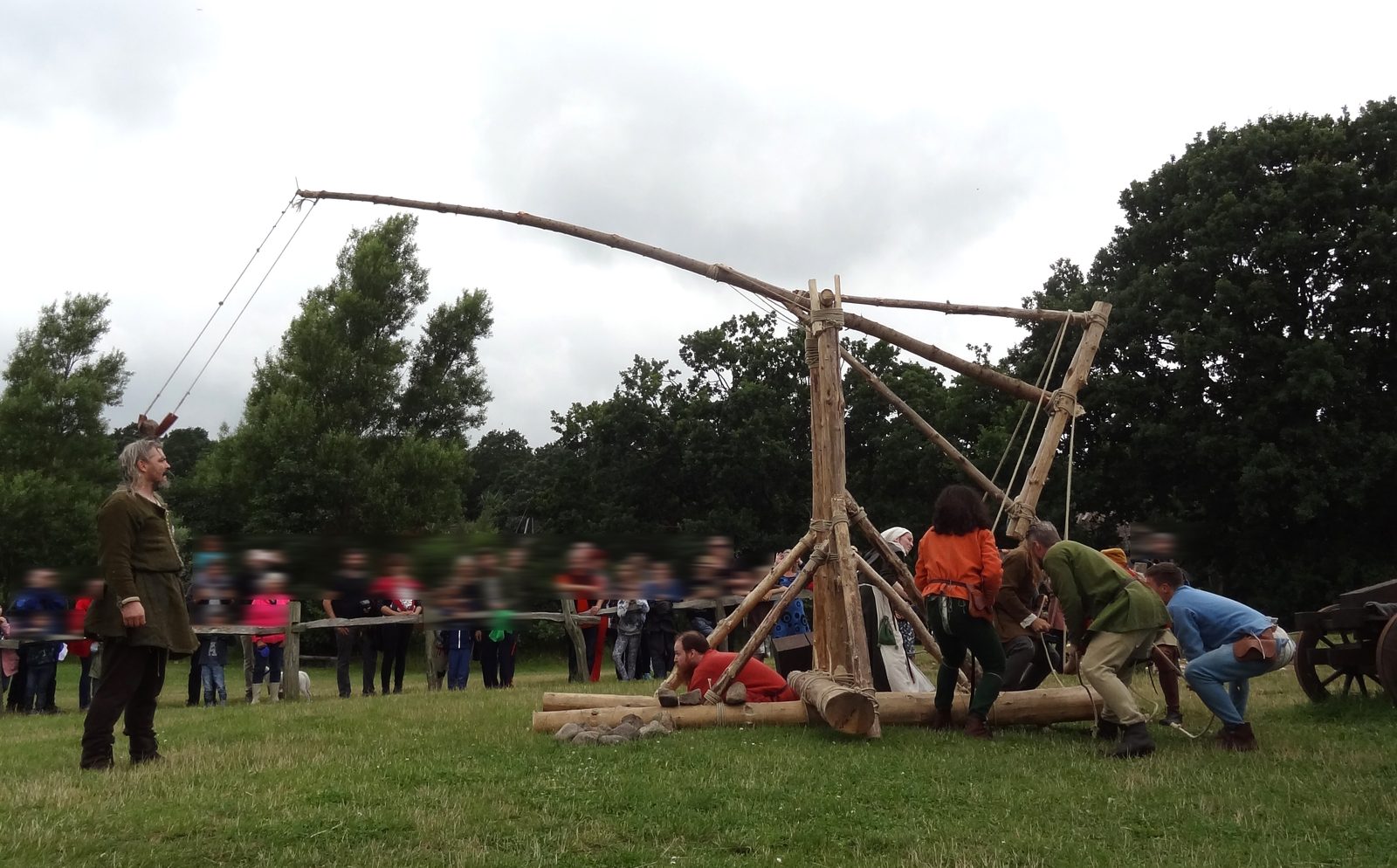
The traction trebuchet is one of the most underestimated weapons in military history. Conventional wisdom holds that trebuchets required extensive logistics, specialised engineering knowledge, and significant time to construct and deploy. Our research challenges these assumptions through hands-on experimental archaeology — building, operating, and testing traction trebuchets to understand their true capabilities and limitations.
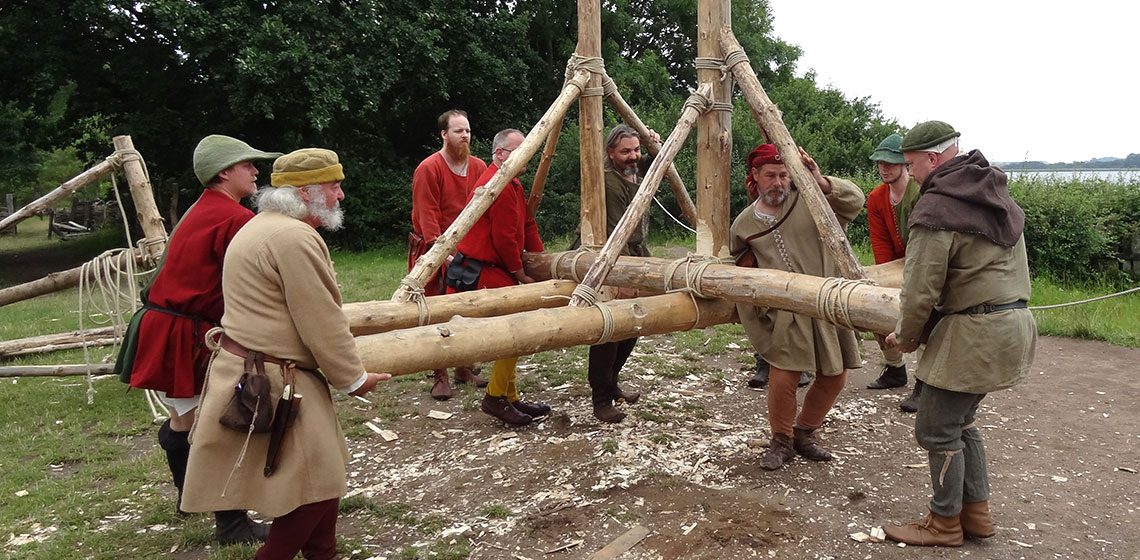
Between 2008 and 2017, we built 13 traction trebuchets across multiple locations: at university grounds in Gjøvik, Norway, at the Medieval Festival at Hamar, Norway, and at Middelaldercenteret (the Medieval Centre) in Nykøbing Falster, Denmark. Each build provided new insights into the construction techniques, materials, crew requirements, and operational realities of these machines.
Historical Context
The first known description of a traction trebuchet in European sources comes from the account of the siege of Thessalonika in the late 6th century. The chronicler describes a weapon previously unknown to the defenders — a beam mounted on a pivot, pulled by ropes, launching stones over the city walls. The technology likely originated in China and spread westward along trade and conquest routes.
By the time of the Siege of Paris (885–886 CE), traction trebuchets were a standard component of siege warfare. The Frankish defenders deployed them from the city walls against Viking besiegers, and the Vikings themselves built trebuchets to attack the fortifications. Contemporary accounts describe dozens of machines operating simultaneously.
The Maciejowski Bible (c. 1250) contains some of the most detailed contemporary depictions of traction trebuchets in operation. These illuminations show the crew arrangement, the pulling ropes, and the general proportions of the machines — providing invaluable reference material for reconstruction efforts.
Al-Tarsusi, writing his military manual for Saladin in the late 12th century, provides one of the most detailed technical descriptions of traction trebuchet construction and operation, including crew sizes, arm proportions, and tactical deployment guidance.
Key Findings
Build Time: A functional traction trebuchet can be constructed in 12 to 30 hours of labour, depending on crew experience and materials available. This is dramatically faster than conventional estimates suggest, and means a besieging army could construct multiple machines in a single day.
Rate of Fire: An experienced crew can launch up to 4 projectiles per minute. This means a single traction trebuchet crew can fire approximately 30 projectiles in the time it takes a counterweight trebuchet to fire just one. This volume of fire fundamentally changes the tactical calculus of siege warfare.
Mobility: A traction trebuchet can be carried and repositioned by as few as 9 people. This makes the weapon far more tactically flexible than counterweight machines, which require extensive engineering to move once constructed.
Reliability: With consistent crew technique, the machines achieve a lateral spread of approximately 5 metres at range. While not precision weapons, this consistency means that a sustained bombardment can systematically destroy walls, structures, or morale within a targeted area.
Machine Components
The traction trebuchet is a deceptively simple machine. Each component serves a specific mechanical purpose, and the design tolerates significant variation in materials and construction quality.
Breakage & Failure Modes
The throwing arm is the component most prone to breakage. Arms made from dry timber are particularly susceptible to catastrophic failure — they snap suddenly and without warning, sending fragments in unpredictable directions.
Green (freshly cut) wood behaves very differently. When a green wood arm fails, the fibres tear and separate gradually rather than snapping cleanly. The arm “breaks soft” — losing power progressively rather than failing catastrophically. This makes green wood significantly safer for crew members.
When components fail, the machines tend to slump rather than collapse. The structure settles downward as joints loosen or members crack, rather than toppling sideways or breaking apart violently. This predictable failure mode means that even a damaged machine poses relatively limited danger to its crew.
Safety Considerations
Based on our experience across 13 builds and hundreds of shots, we established the following safety clearances for public demonstrations:
Behind the machine: 50 metres minimum clearance. Misfires and sling failures can send projectiles backward, though with less energy than a forward shot.
In front of the machine: 120 metres minimum clearance. This accounts for maximum range plus a safety margin for unexpected high-energy shots or projectile bounce and roll.
To the sides: Audiences may be positioned as close as 15 metres to the side of the machine. The lateral deviation of projectiles is highly predictable and rarely exceeds a few metres from the centreline of fire.
These clearances were developed through empirical observation and err on the side of caution. All public demonstrations were conducted with spotters and clear range control procedures.
Hjelsvold, S. & McCallum, S. (2018). “Traction Trebuchet.” EXARC Journal, Issue 2018/3.
https://exarc.net/issue-2018-3/at/traction-trebuchet