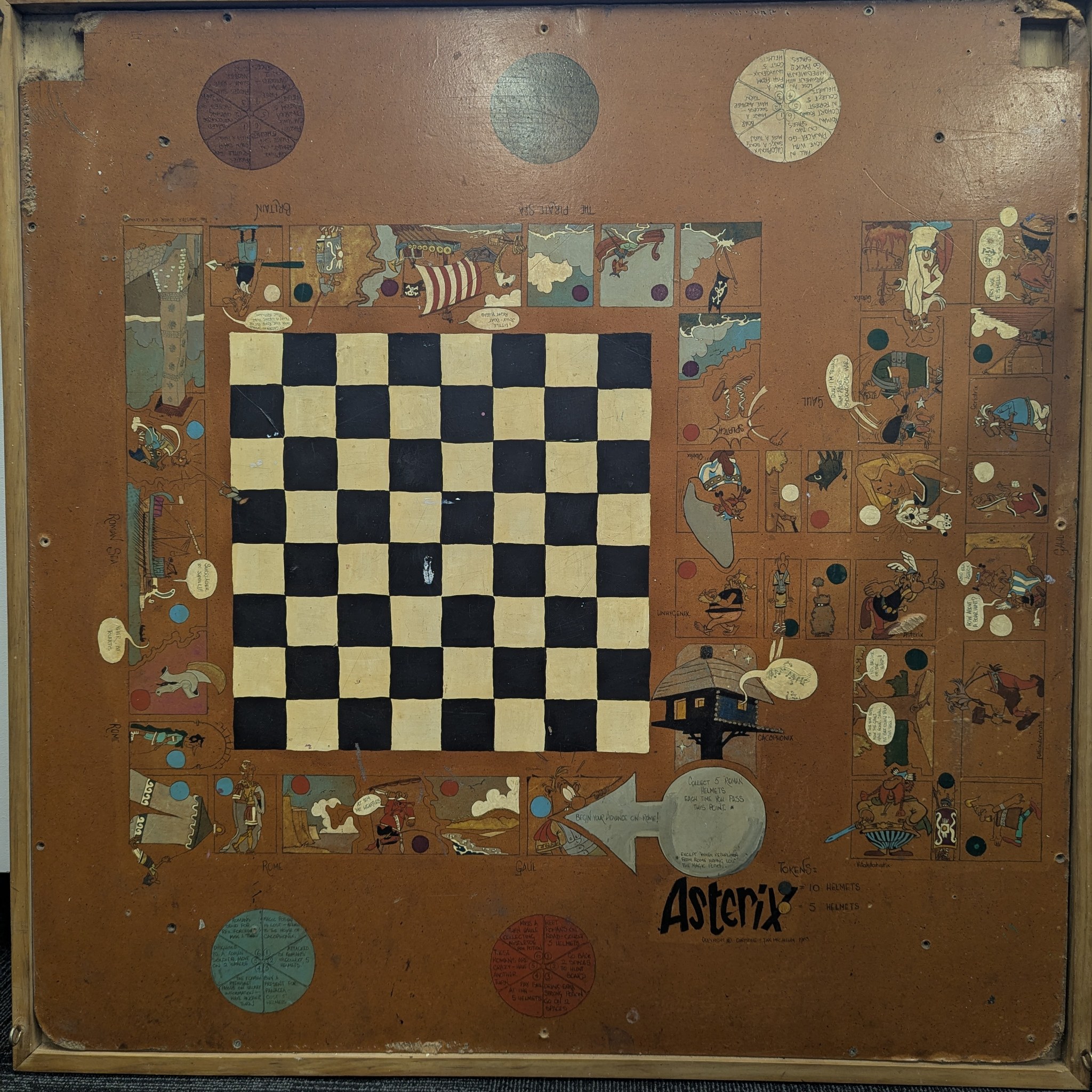
My parents separated when I was seven. My father moved to Auckland; my mother stayed in Greymouth. Dad didn't have much space, so he built bunk beds for my brother and me. This gave him some space to be creative and he designed and created play table built into the bunks.
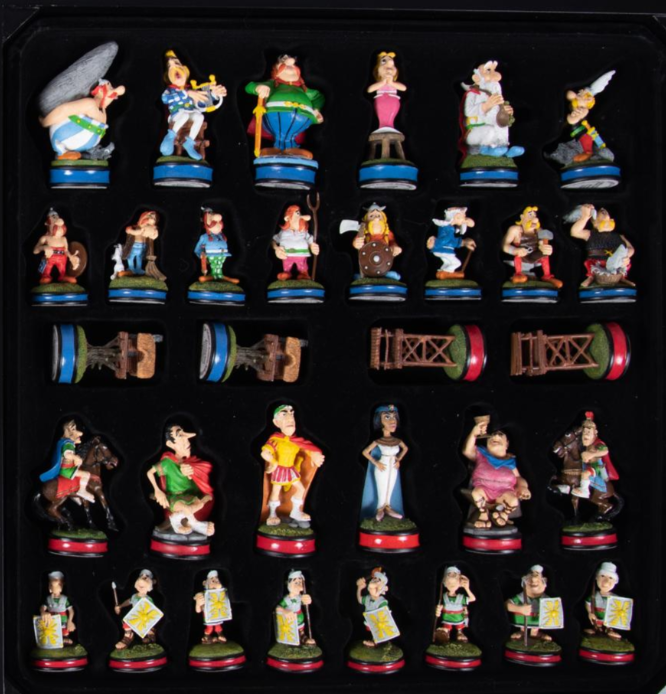
He wanted a chess board on that table. We both played chess, and we liked Asterix. So my father, an educational psychologist by trade and not a game designer by any stretch, sat down and made an Asterix board game from scratch.
Two opposite games on one board
What strikes me now, looking back, is that this single board holds two extremes of the skill lens on game design.
In the centre sits chess — a pure game of no chance. Perfect information, zero randomness, the better player wins most of the time. Skill is everything.
Around the edge runs my father's circuit game, which is the opposite: a fate simulator. You roll a die to move around the ring of comic panels. You land on a coloured circle, roll again, and read your fortune off the matching wheel — collect helmets, pay a toll, miss a turn, get sent back, leap forward. First to 50 helmets wins. There is no decision anywhere in the raw rules. It is a random walk through an Asterix story, dressed as a game.
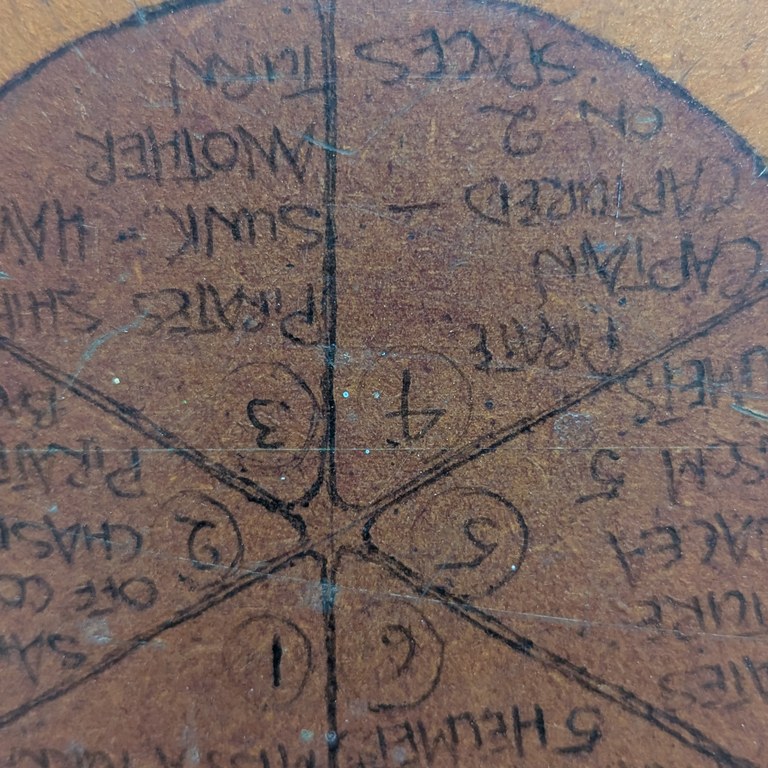
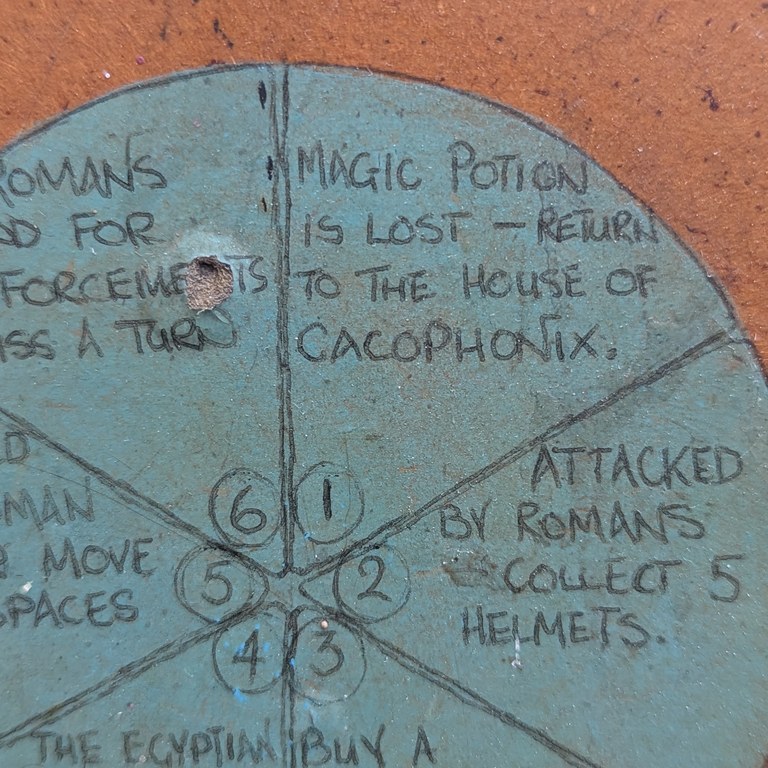
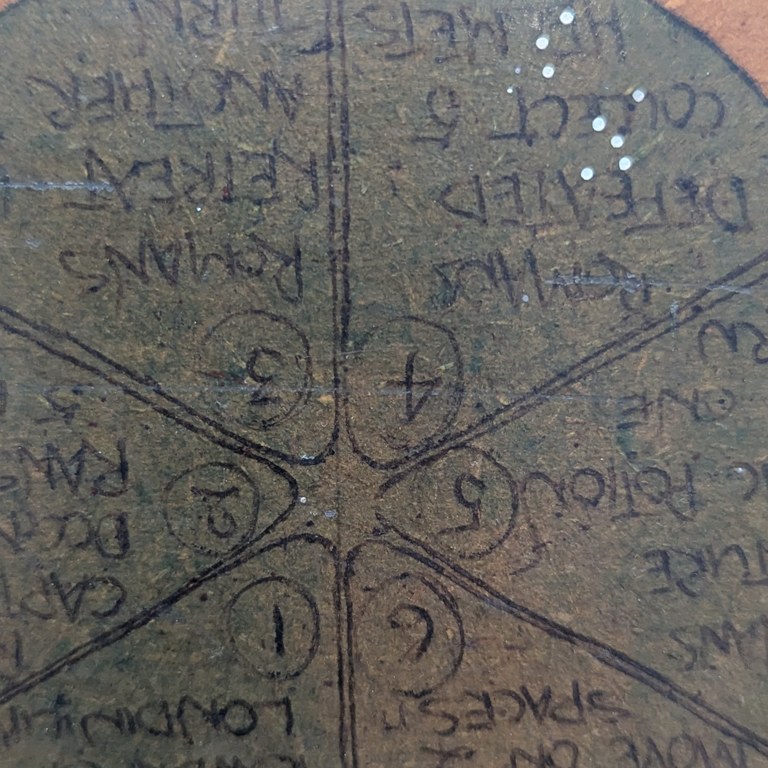
Three of the five fate wheels, each divided into six numbered outcomes, hand-written and faded over the decades. Coloured dots on the track tell you which wheel to read.
That's not an accident of the medium, either. Snakes and Ladders, the game my father's circuit most resembles, was created as the Indian game Moksha Patam, an explicitly religious fate simulator: a tool to teach that your choices are meaningless, that virtue and vice carry you up and down a path already laid out for you. A game of pure fate is, quite literally, a sermon about predestination.
Why an eight-year-old loved it
One of the features of games of pure chance: they are great equalisers. I was eight. My brother was eleven. In chess he beat me every single time, he was better. But on the outer ring of that same board, skill was irrelevant - I could win.
The systems of a game decides who can win before anyone sits down to play.
For a kid, that mattered enormously. It was my first visceral lesson that the shape of a game — not the theme, not the art — is the thing.
House rules, and the start of a designer
We played it a lot, and we ran straight into the problem. A game whose winner is simply "whoever rolled better" turns out not to be much of a game it's a story you watch happen to you. So we did what kids do: we invented house rules to inject agency into the game. Small choices. A way to spend helmets. A way to influence the roll. We were, without the vocabulary for it, balancing the game — pulling that dot on the chance-versus-skill line away from pure fate and back toward something you could play well.
I started reading choose-your-own-adventure books — fate, but with branches, with choice. Then Dungeons & Dragons (the red box, levels 1–3 only, because that's all we had). I started thinking about randomness, balance, and agency — the questions I've never really stopped asking.
I believe that hand-painted board was the first board game ever made in my family. My father wasn't trying to start anything. He just wanted his two sons to have something to play on the table he'd built into their beds. But somewhere between the chessboard in the middle and the fate wheels around the edge, he gave me the whole spectrum of what a game can be — and the question that became a career.
From hardboard to the browser
This is a faithful digital remake of that board, built in Godot 4.7. The art is extracted from photographs of the original, the comic panels, the five fate wheels, and the hand-lettered title are the real thing. Play it solo against the computer in your browser, or online with friends — a small piece of family history, restored and shared.
AI for creative support
I used Claude Code to help code up this game. It combines multiplayer work I have done for my Computer Graphics and Games courses and Game programming courses. The art, the rules, the story are authentic connections to my childhood. I have made games in Godot and can code all the lines of code in the repo, but the code was not the point. This is a way to use AI to help bring to life a game which I did not have the time to code on my own. AI as a tool to surface parts of my families creative history.